Osaka: a dense workshop economy behind the bayside plants
Osaka's industry is really two industries sharing a map. One is the bayside belt of chemical, materials and battery plants built on reclaimed ground with berths at the water. The other is a fabric of very small workshops — machining, pressing, plating, grinding, spring winding — packed into the eastern districts and neighbouring cities, each performing one operation well for somebody else's product. The second is harder to see, harder to replace, and its future rests on whether ageing owners find successors.
- Hub type
- industrial city
- Country
- Japan
- Location
- Osaka sits at the head of Osaka Bay in western Japan and anchors the Kansai region, with industry running from the reclaimed bay frontage into the dense eastern suburbs.
- Logistics connections
- container terminals in Osaka Bay, international air cargo through the offshore Kansai airport, expressway ring linking the waterfront to inland districts, coastal industrial land with dedicated berths
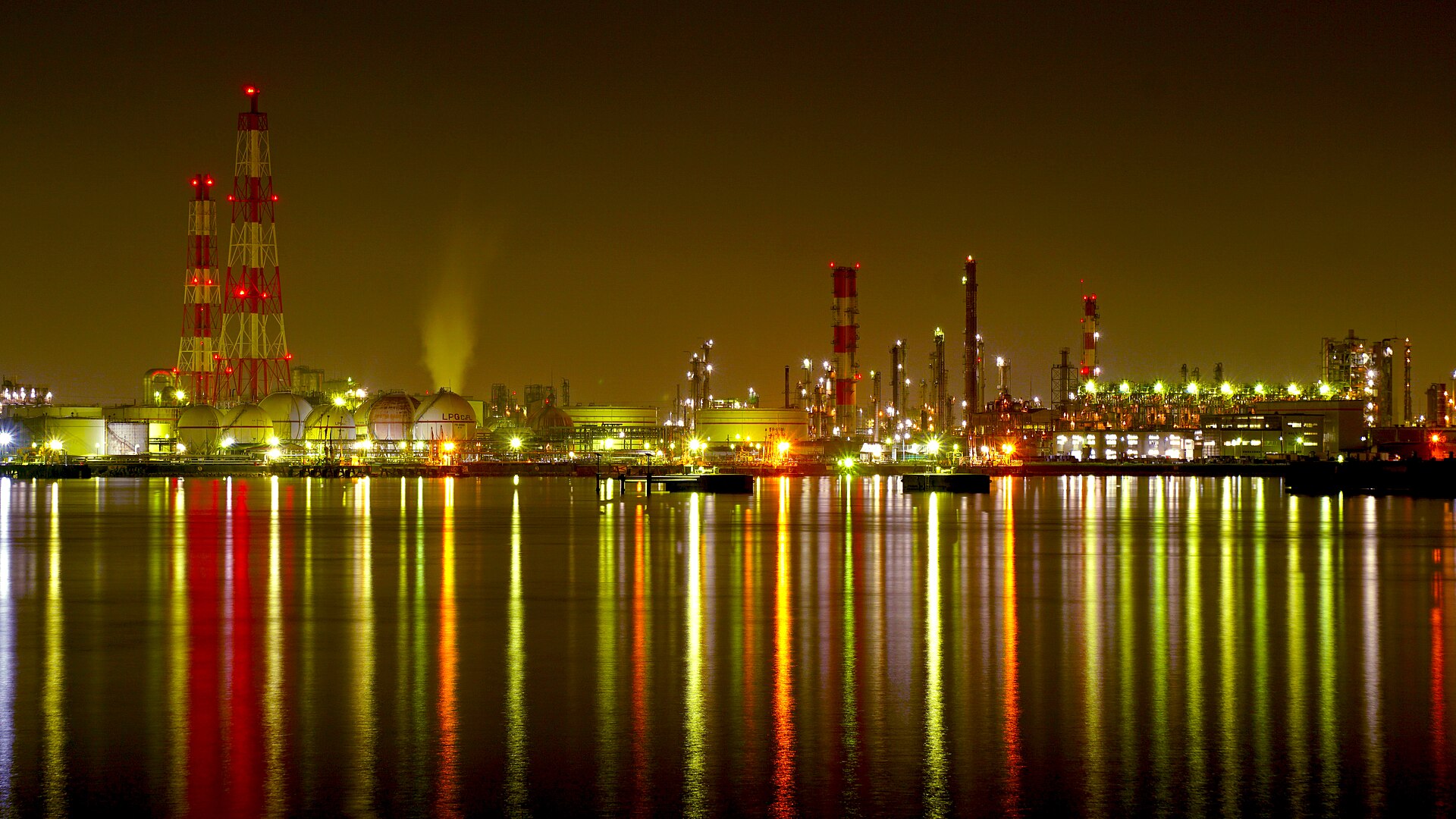
Two industrial cities occupying the same ground
The bay frontage holds what needs land, water and a berth: chemical production, materials, batteries and heavy processing, sited where feedstock arrives by ship and effluent handling was planned in from the start. A short distance inland the pattern inverts completely. Streets of workshops, many with a handful of employees, sit between houses and small warehouses, each holding one or two machines and one specialism. Neither half functions like the other. The bay operates on capital and permits; the workshops operate on personal relationships, drawings passed between neighbours, and the ability to turn a small job around quickly.
What the workshop base gives a product engineer
Access to single-operation specialists is the real offering. A prototype needing a pressed bracket, a ground shaft, a plated finish and a small welded frame can be routed through four workshops within a few kilometres, each doing its part properly and none demanding a minimum order that makes the exercise pointless. Tolerance work and difficult materials are handled routinely. The cost sits with coordination: nobody in that chain manages the whole part, so either the buyer takes on scheduling, inspection and logistics between shops, or a coordinating firm does it and prices accordingly. Foreign buyers usually underestimate that overhead.
Chemicals, materials and the reclaimed frontage
Process industry concentrated on the bay for the ordinary reasons: imported feedstock arrives by sea, cooling water is available, and reclaimed parcels were laid out large enough for plants with hazard separation. Materials chemistry has been an enduring strength, feeding electronic materials, battery components and specialty products rather than commodity volume, which suits a country importing most of its raw inputs. Energy cost is the visible pressure on those operations, and process safety regulation shapes what may be sited where. Expansion room is limited, so investment tends to appear as replacement of a line rather than as new ground being taken.
The succession question nobody has solved
A workshop's capability lives in its owner. When that owner reaches retirement with no successor and no buyer, the machines are sold and a specialism disappears from the region rather than transferring to a competitor. This is the defining structural risk in Kansai's small-manufacturer base, and it is well documented as a national concern. Responses include business transfer matching, consolidation into slightly larger groups, and automation that reduces the dependence on a single pair of hands. None of them work quickly. For a buyer, it means verifying that a supplier's knowledge is written down and shared, not only demonstrated.
How to buy from a fragmented base
Start by deciding who integrates. Either appoint a coordinating manufacturer that subcontracts locally and carries responsibility for the finished part, or accept that your own engineering team will manage several small suppliers directly, in Japanese, on Japanese drawing conventions. Second, expect quality evidence to be delivered differently: many small shops produce excellent parts with sparse documentation, so agree what records you need before the first order rather than auditing afterwards. Third, allow time. Relationships here are built slowly and price is rarely the opening subject, but supply once established is unusually stable.
Industrial sectors present
- metal fabrication
- machinery manufacturing
- chemicals manufacturing
- pharmaceutical manufacturing
- battery manufacturing
- industrial equipment manufacturing
Frequently asked questions
- Why would a foreign buyer source small parts here at all?
- For difficulty rather than for price. The workshop base handles tight tolerances, awkward materials and very small quantities that volume suppliers decline, and it does so with a level of process judgement that is expensive to find elsewhere. Prototype and pre-production work is where that pays. For steady high-volume production of a simple part, the economics rarely favour this base, and local firms themselves often place such work elsewhere.
- How does the region compare with Japan's automotive belt?
- The organising principle differs. Central Japan's supply base is arranged in tiers beneath a small number of vehicle assemblers, with long contractual relationships and shared production discipline. Kansai's small manufacturers serve many customers across many industries, so they are more independent, more varied and less predictable in capability. That makes the region better for specialised or exploratory work and less suited to programmes requiring a whole tier structure to move in step.
- What should due diligence look at in a small supplier here?
- Ask who else can run the critical operation if the owner is unavailable, and whether the setup knowledge exists as written procedure or only as habit. Look at the age profile of the workforce and whether an apprentice is being trained. Check the maintenance state of key machines, since replacement capital is often the constraint. Finally, establish whether the firm exports directly or has only ever sold domestically, because export documentation and packaging are frequently the weakest link.
Data limitations
- Manufacturing figures are operator-supplied inputs, not market data. GeoBusinessIQ holds no factory costs, production volumes, yields, cycle times, tooling prices or capacity data and does not estimate them — every result reflects only the figures you enter.
- No manufacturer, supplier, vendor or factory is recommended, rated or ranked anywhere in this cluster, and no directory of them is published. Selection material describes how to run your own assessment; the assessment itself remains yours.
Explore the graph
Industries present
- Agricultural machinery manufacturing: building all year for a season that will not wait
- Battery production: choosing which link of the chain to occupy
- Commodity chemicals manufacturing: continuous plants, feedstock spreads and turnaround discipline
- Industrial equipment manufacturing: modular platforms and the slow bleed of option sprawl
- Machinery manufacturing: selling a promise, then financing it through milestones
- Pharmaceutical manufacturing: campaign scheduling under a release process nobody can rush
Sources
- Japan External Trade Organization — JETRO (accessed )Covers: Japanese trade and investment promotion, including regional industrial profiles and sector information.Does not cover: Company-level data, site costs, or investment advice.Why it matters: Cited on Japanese industrial hub pages for regional industrial composition.Review cadence: annual
- United Nations Industrial Development Organization — UNIDO (accessed )Covers: Industrial development analysis, industrial statistics methodology, and manufacturing capability programmes across member states.Does not cover: Company-level data, factory costs, supplier information, or real-time production statistics.Why it matters: The United Nations agency for industrial development; used for structural framing of how manufacturing sectors develop, never for point figures.Review cadence: annual
- OECD — OECD — economic and tax statistics (accessed ; reviewed )Covers: Comparable corporate tax, statutory rate, and economic indicators across member and partner economies.Does not cover: Effective tax rates, deductions and incentives, local surtaxes, and personal residency rules.Why it matters: Used as a cross-country baseline to sanity-check rates against primary tax-authority figures.Review cadence: Annual, plus on major statutory changes.
Educational and operational information only. This page describes an industrial location qualitatively; it publishes no output, employment, plant-count or ranking figures, names no individual manufacturer as a recommendation, and is not investment, siting, legal, or tax advice.
Last updated: