Rotterdam: process industry built around a deep-water port
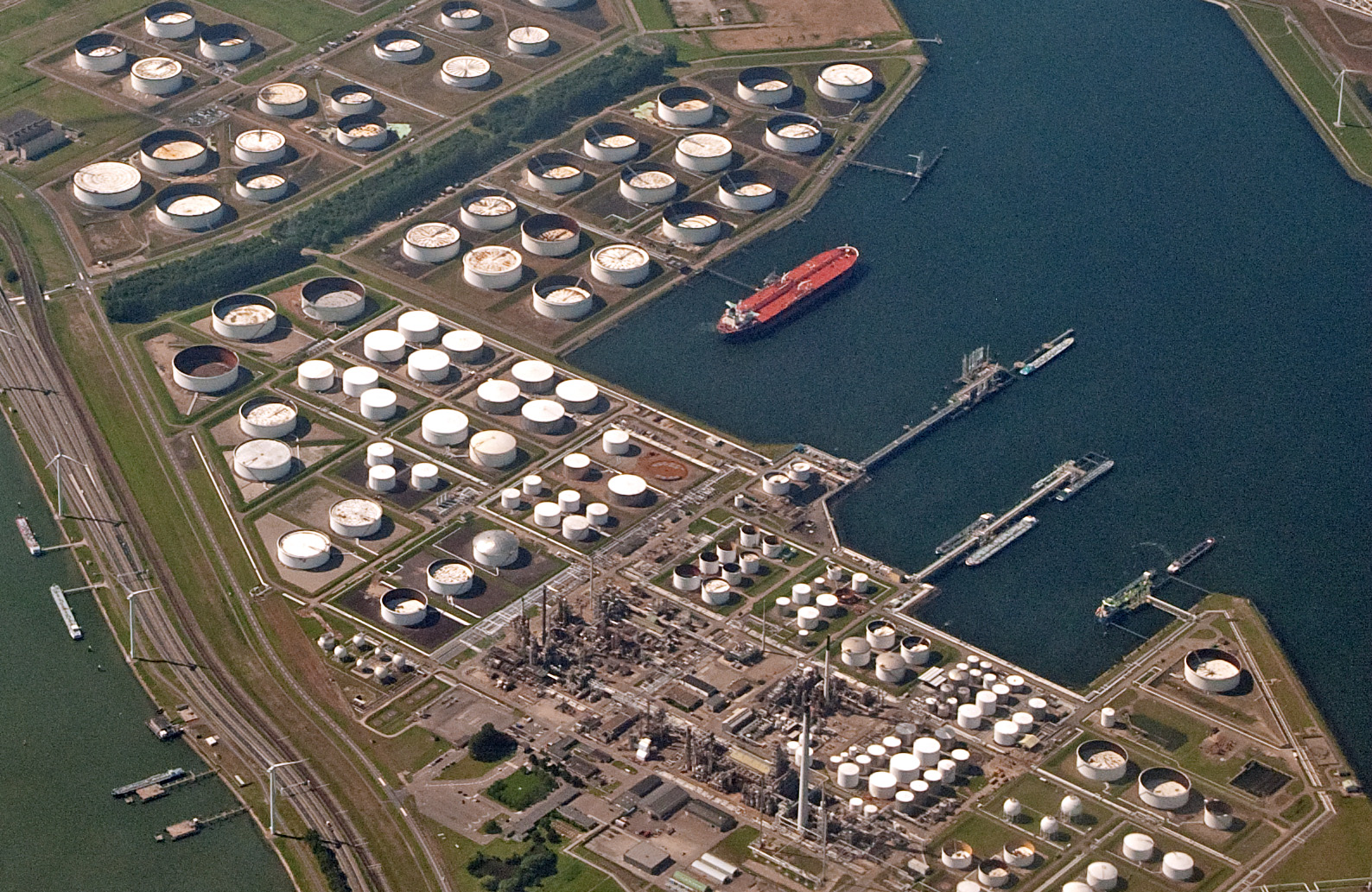
The industry along this waterway exists because ocean vessels can reach it and because pipelines run inland from it. Refining, petrochemical production, tank storage, industrial gases and food processing occupy a strip of made ground running toward the sea, connected to customers in the Netherlands, Belgium and Germany by pipe, barge and rail. It is a process cluster in the strict sense, since the plants are physically plumbed to each other.
- Hub type
- industrial cluster
- Country
- Netherlands
- Location
- The cluster runs west from Rotterdam in the Dutch province of South Holland along the waterway to the North Sea, occupying reclaimed land and dock complexes on both banks.
- Logistics connections
- deep-water terminals reachable by ocean vessels without draught restriction, dedicated freight railway running inland to the German network, Rhine barge services to the interior, product pipelines linking the cluster to Antwerp and the Ruhr, liquid bulk and tank storage terminals
Plumbing, not proximity
Most industrial clusters are places where similar firms happen to be near each other. This one is physically interconnected: the output of a refinery is the feedstock of another plant, delivered by pipe, and hydrogen, steam, nitrogen and utilities move between operators on long-term contracts. That integration is the source of the cluster efficiency and of its rigidity. A plant cannot easily relocate because its inputs arrive through fixed infrastructure, and a change at one link propagates. For anyone considering an industrial site here, the first question is not land but which existing streams the process can connect to, since that determines whether the economics work at all.
What deep water and tank storage make possible
Vessel access without draught restriction is the founding advantage, and it produced a storage and blending industry alongside the manufacturing one. Crude, products, chemicals, vegetable oils and biofuels arrive in ocean quantities, are stored, blended and redistributed in smaller parcels by barge, coaster, rail and pipe. That function is commercially distinct from production but supports it, because a manufacturer can source feedstock in flexible quantities without owning inventory infrastructure. It also makes the cluster a price-setting point for several traded products, which means feedstock costs here track international markets closely rather than reflecting a local supply position.
Decarbonisation as an active construction programme
The emissions profile of the cluster has made it the site of a sustained transition effort: electrification of process heat, hydrogen production and import terminals, carbon capture with offshore storage, and connections to offshore wind. This is not a policy discussion here but a construction pipeline, and it affects operating manufacturers directly through grid connection queues, permitting timescales, contractor availability and shared infrastructure decisions. A new entrant should assume that energy supply arrangements and emissions obligations will change materially over the life of a plant, and should treat flexibility in energy sourcing as a design requirement. Grid capacity in particular is a live constraint across the region.
Operating labour, contractors and turnarounds
Process plants need a permanent core of operators, control room staff and maintenance trades, plus a much larger contractor workforce mobilised for turnarounds and construction. That contractor market is regional and shared across operators, so scheduling a major shutdown means competing for scaffolders, welders, insulators and inspection specialists with neighbouring plants. Availability is genuinely tight during heavy investment periods, and it drives both cost and duration of maintenance work. Firms operating here plan turnarounds years ahead for that reason. Permanent staffing draws on Dutch vocational training in process technology alongside substantial cross-border and international recruitment.
Siting realities on made ground
Land here is reclaimed, allocated and heavily regulated, and it is not simply purchased. Sites are leased from the port authority under conditions that specify use, and environmental permitting for a process installation is detailed, public and slow. External safety rules govern how close hazardous installations may sit to each other and to populated areas, constraining what can go where. Nitrogen deposition rules have also complicated permitting for new industrial activity across the country. None of this is unusual for heavy industry in a dense country, but it means the programme for establishing a plant is dominated by consent rather than construction.
Industrial sectors present
- chemicals
- specialty chemicals
- plastics
- food
- shipbuilding
- industrial equipment
- metal fabrication
Frequently asked questions
- Why can process plants here not simply be relocated?
- Because their inputs and outputs move through fixed infrastructure. A cracker or refinery is connected by pipeline to storage, to neighbouring plants and to customers inland, and it draws steam, hydrogen and industrial gases from shared systems under long contracts. Reproducing those connections elsewhere costs more than the plant itself. That is why the cluster persists even as individual product economics change, and why new entrants evaluate connection points before they evaluate land.
- What role does the dedicated freight railway play?
- It gives the cluster a rail route inland that does not share capacity with passenger traffic, which matters for chemical and container volumes moving toward Germany. Combined with Rhine barge services and product pipelines, it means goods can leave the area by three modes that do not compete for the same infrastructure. For manufacturers, the practical benefit is resilience, since congestion or restriction on one mode does not halt outbound flow, although each mode suits different cargo.
- How should a manufacturer approach energy supply here?
- As a variable rather than a given. Electrification, hydrogen supply, carbon capture connections and grid reinforcement are all being built simultaneously, and connection capacity is rationed in places. A plant designed around one energy source and one price assumption is exposed. Firms establishing here typically engage the network operator and the port authority early, design for more than one heat source where possible, and treat emissions obligations as a cost line that will grow.
Data limitations
- Manufacturing figures are operator-supplied inputs, not market data. GeoBusinessIQ holds no factory costs, production volumes, yields, cycle times, tooling prices or capacity data and does not estimate them — every result reflects only the figures you enter.
- No manufacturer, supplier, vendor or factory is recommended, rated or ranked anywhere in this cluster, and no directory of them is published. Selection material describes how to run your own assessment; the assessment itself remains yours.
Explore the graph
Industries present
- Commodity chemicals manufacturing: continuous plants, feedstock spreads and turnaround discipline
- Food manufacturing: perishable inputs, retailer promotions and the allergen changeover
- Frozen food manufacturing: where freezing capacity and energy set the ceiling
- Industrial equipment manufacturing: modular platforms and the slow bleed of option sprawl
- Pet food manufacturing: feed rules, human-food expectations, long shelf life
- Plastics manufacturing: a conversion-margin business, not a materials business
Supply chain context
Sources
- Port of Rotterdam Authority — Port of Rotterdam Authority (accessed )Covers: Port of Rotterdam infrastructure, terminals, hinterland connections and port operating procedure.Does not cover: Carrier rates, terminal commercial terms, or third-party throughput rankings.Why it matters: The authority that develops and manages the port area; the primary source for what the port physically offers and how it connects inland.Review cadence: as published
- Netherlands Enterprise Agency — RVO (accessed )Covers: Dutch enterprise, innovation and sustainability programmes, including industrial support and permitting information.Does not cover: Permit decisions, or company-level data.Why it matters: Cited for the Dutch industrial operating and permitting environment.Review cadence: annual
- Eurostat — Eurostat — official statistics of the European Union (accessed ; reviewed )Covers: EU-harmonised VAT rates and economic statistics for EU/EEA member states.Why it matters: Used for EU VAT and member-state economic figures where an EU-harmonised series is preferable.
Educational and operational information only. This page describes an industrial location qualitatively; it publishes no output, employment, plant-count or ranking figures, names no individual manufacturer as a recommendation, and is not investment, siting, legal, or tax advice.
Last updated: